
Cart
GHK-Cu
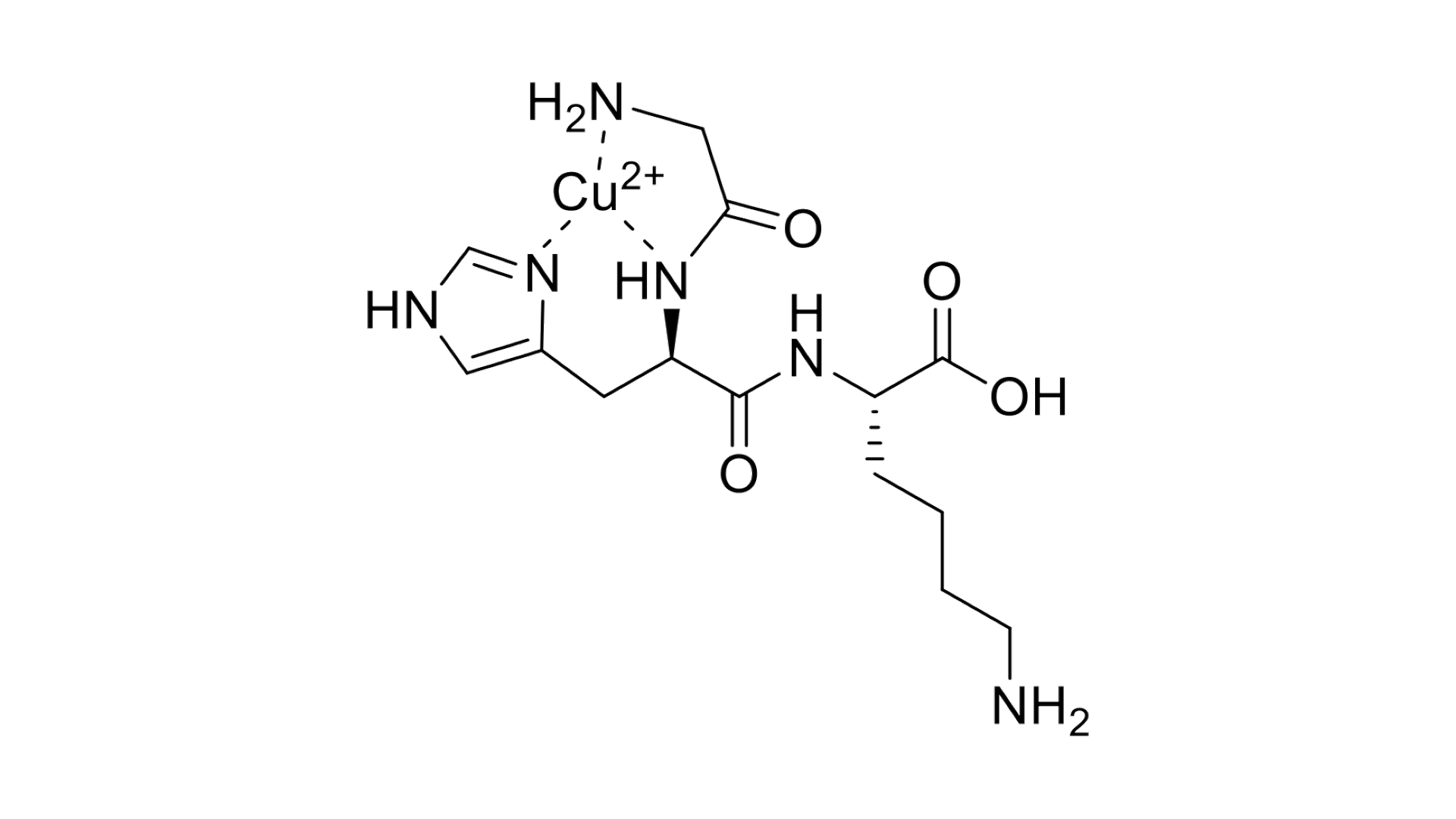
Chemical & Technical Specifications
| Compound | GHK-Cu |
|---|---|
| CAS Number | 89030-95-5 |
| Molecular Formula | C14H22CuN6O4 |
| Molecular Weight | 401.9 g/mol |
| Peptide Sequence | Gly-His-Lys (complexed with Copper) |
| Synonyms | Copper Tripeptide-1, Glycyl-L-Histidyl-L-Lysine Copper |
What is GHK-Cu?
GHK-Cu is a naturally occurring peptide found in the human body. It consists of three amino acids — glycine, histidine, and lysine — bound to a copper ion. The peptide is also available in its free form, then simply referred to as GHK, but GHK-Cu is the most well-known form. Besides copper ions, GHK also shows affinities for other biologically important metals such as zinc, cobalt and iron. This small molecule was first identified in human blood plasma in 1973.1
GHK-Cu is produced inside the body as a cleavage product of larger proteins, such as albumin.1 Its concentration is highest in young individuals and declines significantly with age. In early adulthood, the levels are at their maximum and drop more than 50% at the age of 60.2
Because of this age-related decrease, researchers became interested in whether restoring GHK-Cu levels might help reverse certain aspects of aging and tissue damage.
The peptide is also thought to act as a biological signaling molecule, instructing cells to repair damaged tissue, regulate inflammation, and restore healthy gene-expression patterns in abnormal cells.3 Rather than forcing cells into abnormal activity, GHK-Cu’s role is likely to help tissues return to a more functional state.
Mechanisms of Action
Although research continues, several mechanisms have been proposed to explain GHK-Cu’s wide range of effects.
1. Gene Regulation
GHK-Cu appears to activate genes associated with tissue repair while suppressing genes linked to inflammation and degeneration. This broad regulatory influence may explain why a small peptide can produce diverse physiological outcomes.3
2. Copper Delivery
Copper is an essential trace mineral required for enzymes involved in:
- antioxidant defense
- collagen cross-linking
- mitochondrial energy production
GHK acts as a copper carrier, safely transporting copper ions into cells where they are needed without causing toxicity.
3. Anti-Inflammatory Signaling
Chronic inflammation contributes to aging and many diseases. GHK-Cu reduces inflammatory cytokines and promotes resolution of inflammation rather than simply blocking immune activity.
4. Tissue Remodeling
The peptide balances tissue breakdown and rebuilding, allowing damaged structures to be replaced with healthier ones.
Efficacy and Effects of GHK-Cu
Cell Studies
In the earliest available study that focuses on the effects of GHK-Cu, it was reported to promote the survival and growth of liver cells. The authors of the study had previously treated liver with blood from young patients and found significant improvements in liver function parameters. Later, they reported that GHK was responsible for this positive effect.4 It was later thought that GHK-Cu was responsible to aid in copper uptake into the liver cells.5 It is today generally assumed that GHK-Cu has the ability to regulate the uptake of copper and zinc into cells and onto other biomolecules, and there is indirect evidence to support this assumption.6
In fibroblast cultures — the cells responsible for producing connective tissue in skin and in other tissues — GHK-Cu significantly increased collagen synthesis at very low concentrations.7,8 This also highlighted potential cosmetic applications, as collagen partially provides structural strength to skin. Aging reduces collagen production, contributing to wrinkles and slower wound healing. Besides collagen, GHK-Cu also increases the production of many further components of connective tissues, such as the glycans decorin and biglycan.9
The peptide also appears to regulate matrix metalloproteinases (MMPs) — enzymes that break down damaged tissue. Balanced activity of these enzymes is essential for proper remodeling during healing.10 It was also reported to aid in the formation of new blood vessels.11
Another important observation is the peptide’s effect on inflammation. GHK-Cu reduces levels of inflammatory signaling molecules while increasing antioxidant enzyme activity such as superoxide dismutase. This helps protect cells from oxidative stress, a major contributor to aging and chronic disease.12
Animal Studies
An experimental silicosis mouse model was established to observe the effects of GHK-Cu on lung inflammation and remodeling. These effects were partly related to the inhibition of the CS-induced oxidative stress in white blood cells induced by GHK-Cu. Thus, the results suggest that GHK-Cu acts as a potential drug by attenuating oxidative stress. This, in turn, attenuates the progression of pulmonary inflammation and fibrosis, which provides a reference for the treatment of silicosis. During the study, a molecular target, peroxiredoxin 6 (PRDX6), has been identified, and GHK-Cu can bind to PRDX6, thus attenuating lung inflammation and fibrosis in silicosis mice without significant systemic toxicity.13
In a new study on zebrafish embryos, it was also shown that GHK-Cu has anti-inflammatory effects. It reduced the migration of immune cells and the production of pro-inflammatory cytokines. A reduction of oxidative stress was also shown during the same study.14
In a rat model of knee injury, GHK-Cu was evaluated as a compound to increase graft healing after a surgery, like it would be performed after a rupture of the cruciate ligaments, which is one of the more common knee injuries in humans. At 6 weeks post-operation, GHK-Cu groups resulted in a better knee appearance compared to placebo, but there was no significant difference at 12 weeks post-operation. The graft in the 0.3 mg/ml GHK-Cu group had higher stiffness than the saline group at 6 weeks post-operation, but there was no significant difference in load, gait, and histological scores among the treatment groups.15
In a further animal study, eighteen rabbits were divided into three groups: GHK-Cu, zinc oxide and no treatment. After a wound was inflicted, the mean unhealed wound area was significantly smaller in the GHK-Cu than in the zinc oxide group on day 7, and significantly smaller in the GHK-Cu group than in the control group on days 7, 14 and 21. The wound tissue regeneration in the wound bed was significantly faster in the GHK-Cu group than in the other groups as well. The results suggest that GHK-Cu is a better choice in the treatment protocols for open wounds in rabbits than zinc oxide.16 Similar positive effects were observed with GHK-Cu gel in rat wound models.17,18
Human Clinical and Cosmetic Studies
Wound Healing in Humans
A key study on humans was the treatment of foot ulcers in diabetic patients with a gel that contained GHK-Cu. The study, published in 1994, found that treatment with GHK-Cu gel significantly increased the percentage of closure of plantar ulcers (98.5% median area percentage closure compared with 60.8% for vehicle). The rate of closure was three times faster with GHK-Cu gel treatment compared with standard care.19
Interestingly, there are second-hand reports about further studies of topical GHK-Cu gels and creams in humans from the early 2000s. They mostly stem from talks given at annual dermatology congresses and were never published in dermatological journals. They reported mostly positive effects on skin laxity and clarity in small to medium-sized groups of female volunteers.20 However, the original reports are not publicly available.
In addition, there was a registered study completed with 27 patients in 2024 (ID: NCT05932732). However, no results have been posted since completion. An additional study focusing on topical GHK-Cu gel for skin wound healing is in progress as of 2026 (ID: NCT07437586).
Safety and Toxicology of GHK-Cu
There is no explicit data on the safety of GHK-Cu. However, from the absence of reported side effects and adverse events in animal studies and the few available human studies, it can be inferred that GHK-Cu has a good safety profile, at least when applied as a cream. For other forms of application (dermal injection, oral etc.) not enough data is available to support the assumption of safe application.
Stability and Degradation
Peptides are generally vulnerable to enzymatic breakdown, but GHK-Cu demonstrates moderate stability due to its copper binding. Surprisingly, the peptide was stable in water and in pH (4.5–7.4) buffers for at least two weeks at 60 °C. The peptide was susceptible to hydrolytic cleavage under basic and oxidative stressors and, to a lesser extent, acidic conditions. The HPLC in conjunction with mass spectrometry identified three key degradation products, one of which was the constituent amino acid histidine.21
Summary
Current research suggests that GHK-Cu is a multifunctional peptide with significant biological activity. There is good evidence from studies in cell culture and from animal experiments which show the effects of the peptide. Most notably, it has shown a growth-promoting effect on skin components and aids in wound healing and tissue repair. Other properties like the growth promotion of nerve fibers and blood vessels have also been reported, but lack solid evidence.
The evidence in humans remains limited; only a few studies have published results on the topical application of GHK-Cu in patients. In contrast, no credible studies showing that GHK-Cu is effective as an oral or injectable formulation in humans exist. However, the available data points towards a promising topical efficacy in wound healing in humans, but more work is needed to confirm. At the current time, further investigation into the compound is ongoing, but with a slow pace for human clinical trials.
Hence, GHK-Cu is not approved anywhere as an official therapy, but rather is considered a drug candidate which is, as of 2026, not currently undergoing approval trials. Additional peptides derived from GHK-Cu are also undergoing preclinical trials, for example the modification of GHK with D-alanine, which has been shown to exert similar wound-healing properties.22
References
Further reading
- The Laccase-like Property of GHK-Cu and Its Applications in Colorimetric Sensing of Phenolic Compounds (2026)
- An injectable hydroxyapatite microsphere filler loaded with GHK-Cu tripeptide for anti-inflammatory and antioxidant (2025)
- Are We Ready to Measure Skin Permeation of Modern Antiaging GHK–Cu Tripeptide Encapsulated in Liposomes? (2024)
- Liposomes as Carriers of GHK-Cu Tripeptide for Cosmetic Application (2023)
- Synergy of GHK-Cu and hyaluronic acid on collagen IV upregulation via fibroblast and ex-vivo skin tests (2023)
- Glycyl-l-histidyl-l-lysine-Cu2+ rescues cigarette smoking-induced skeletal muscle dysfunction via a sirtuin 1-dependent pathway (2023)
- GHK and DNA: Resetting the Human Genome to Health (2014)
References
- Pickart L, Thaler MM. Tripeptide in human serum which prolongs survival of normal liver cells and stimulates growth in neoplastic liver. Nat New Biol. 1973;243:85–87.
- Pickart L, Vasquez-Soltero JM, Margolina A. GHK Peptide as a Natural Modulator of Multiple Cellular Pathways in Skin Regeneration. Biomed Res Int. 2015;2015:648108. doi: 10.1155/2015/648108.
- Pickart L, Margolina A. Regenerative and Protective Actions of the GHK-Cu Peptide in the Light of the New Gene Data. Int J Mol Sci. 2018;19. doi: 10.3390/ijms19071987.
- Schlesinger DH, Pickart L, Thaler MM. Growth-modulating serum tripeptide is glycyl-histidyl-lysine. Experientia. 1977;33:324–325. doi: 10.1007/BF02002806.
- Pickart L, Freedman JH, Loker WJ, Peisach J, Perkins CM, Stenkamp RE, Weinstein B. Growth-modulating plasma tripeptide may function by facilitating copper uptake into cells. Nature. 1980;288:715–717. doi: 10.1038/288715a0.
- Min J-H, Sarlus H, Harris RA. Glycyl-l-histidyl-l-lysine prevents copper- and zinc-induced protein aggregation and central nervous system cell death in vitro. Metallomics. 2024;16. doi: 10.1093/mtomcs/mfae019.
- Maquart FX, Pickart L, Laurent M, Gillery P, Monboisse JC, Borel JP. Stimulation of collagen synthesis in fibroblast cultures by the tripeptide-copper complex glycyl-L-histidyl-L-lysine-Cu2+. FEBS Lett. 1988;238:343–346. doi: 10.1016/0014-5793(88)80509-X.
- Wegrowski Y, Maquart FX, Borel JP. Stimulation of sulfated glycosaminoglycan synthesis by the tripeptide-copper complex glycyl-L-histidyl-L-lysine-Cu2+. Life Sci. 1992;51:1049–1056. doi: 10.1016/0024-3205(92)90504-I.
- Siméon A, Wegrowski Y, Bontemps Y, Maquart FX. Expression of glycosaminoglycans and small proteoglycans in wounds: modulation by the tripeptide-copper complex glycyl-L-histidyl-L-lysine-Cu(2+). J Invest Dermatol. 2000;115:962–968. doi: 10.1046/j.1523-1747.2000.00166.x.
- Siméon A, Emonard H, Hornebeck W, Maquart FX. The tripeptide-copper complex glycyl-L-histidyl-L-lysine-Cu2+ stimulates matrix metalloproteinase-2 expression by fibroblast cultures. Life Sci. 2000;67:2257–2265. doi: 10.1016/S0024-3205(00)00803-1.
- Lane TF, Iruela-Arispe ML, Johnson RS, Sage EH. SPARC is a source of copper-binding peptides that stimulate angiogenesis. J Cell Biol. 1994;125:929–943. doi: 10.1083/jcb.125.4.929.
- Greco V, Lanza V, Tomasello B, Naletova I, Cairns WRL, Sciuto S, Rizzarelli E. Copper Complexes with New Glycyl-l-histidyl-l-lysine-Hyaluronan Conjugates Show Antioxidant Properties and Osteogenic and Angiogenic Synergistic Effects. Bioconjug Chem. 2025;36:662–675. doi: 10.1021/acs.bioconjchem.4c00545.
- Bian Y, Deng M, Liu J, Li J, Zhang Q, Wang Z, Liao L, Miao J, Li R, Zhou X, et al. The glycyl-l-histidyl-l-lysine-Cu2+ tripeptide complex attenuates lung inflammation and fibrosis in silicosis by targeting peroxiredoxin 6. Redox Biol. 2024;75:103237. doi: 10.1016/j.redox.2024.103237.
- Hu J, Zhang C, Wang F. Glycyl-L-histidyl-L-lysine-Cu2+ (GHK-Cu) attenuates CuSO4- or LPS-induced inflammation in zebrafish larvae model. Eur J Pharmacol. 2026;1023:178880. doi: 10.1016/j.ejphar.2026.178880.
- Fu S-C, Cheuk Y-C, Chiu W-YV, Yung S-H, Rolf CG, Chan K-M. Tripeptide-copper complex GHK-Cu (II) transiently improved healing outcome in a rat model of ACL reconstruction. J Orthop Res. 2015;33:1024–1033. doi: 10.1002/jor.22831.
- Cangul IT, Gul NY, Topal A, Yilmaz R. Evaluation of the effects of topical tripeptide-copper complex and zinc oxide on open-wound healing in rabbits. Vet Dermatol. 2006;17:417–423. doi: 10.1111/j.1365-3164.2006.00551.x.
- Canapp SO, Farese JP, Schultz GS, Gowda S, Ishak AM, Swaim SF, Vangilder J, Lee-Ambrose L, Martin FG. The effect of topical tripeptide-copper complex on healing of ischemic open wounds. Vet Surg. 2003;32:515–523. doi: 10.1111/j.1532-950X.2003.00515.x.
- Arul V, Kartha R, Jayakumar R. A therapeutic approach for diabetic wound healing using biotinylated GHK incorporated collagen matrices. Life Sci. 2007;80:275–284. doi: 10.1016/j.lfs.2006.09.018.
- Mulder GD, Patt LM, Sanders L, Rosenstock J, Altman MI, Hanley ME, Duncan GW. Enhanced healing of ulcers in patients with diabetes by topical treatment with glycyl-l-histidyl-l-lysine copper. Wound Repair Regen. 1994;2:259–269. doi: 10.1046/j.1524-475X.1994.20406.x.
- Gorouhi F, Maibach HI. Role of topical peptides in preventing or treating aged skin. Int J Cosmet Sci. 2009;31:327–345. doi: 10.1111/j.1468-2494.2009.00490.x.
- Badenhorst T, Svirskis D, Wu Z. Physicochemical characterization of native glycyl-l-histidyl-l-lysine tripeptide for wound healing and anti-aging: a preformulation study for dermal delivery. Pharm Dev Technol. 2016;21:152–160. doi: 10.3109/10837450.2014.979944.
- Rakhmetova KK, Mishina ES, Bobyntsev II, Bezhin AI, Vorvul AO. Effects of Gly-His-Lys-D-Ala Peptide on Skin Wound Regeneration Processes. Bull Exp Biol Med. 2024;176:411–416. doi: 10.1007/s10517-024-06035-w.