
Cart
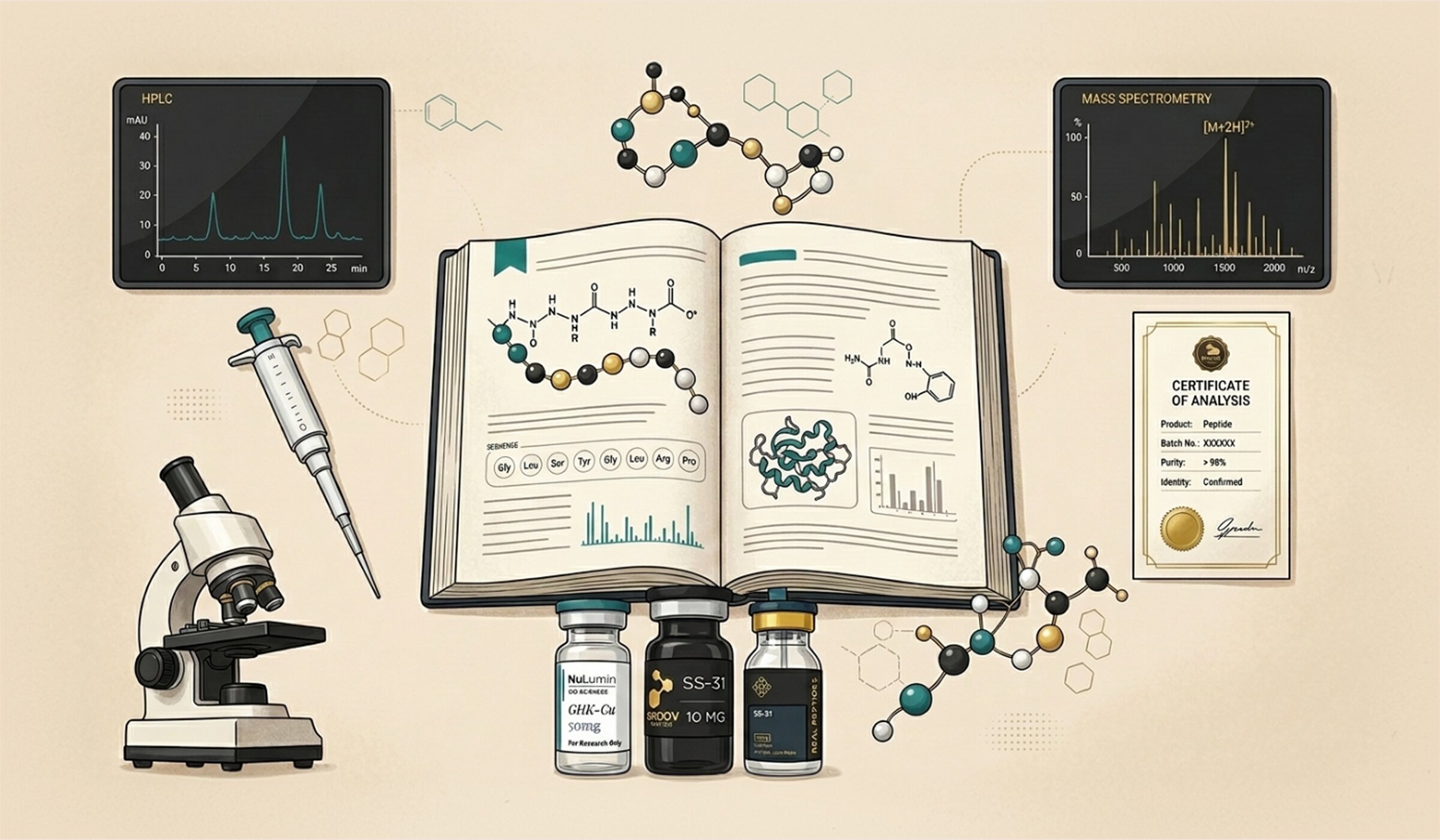
What are Peptides? A Comprehensive Research Reference Guide for Lab Scientists
For laboratory scientists, understanding peptide chemistry, classification, and quality standards is foundational to designing meaningful research protocols. Peptides sit at a crucial intersection of organic chemistry, structural biology, and pharmacology. Whether the work involves receptor binding assays, in vitro stability studies, or animal model investigations, the quality of every downstream conclusion depends on a clear understanding of the molecules themselves.
This guide consolidates the fundamentals of research peptides into a single reference document. It covers chemistry, classification, history, synthesis, certificate of analysis interpretation, solubility and stability, the regulatory landscape, and a tour of the major research peptide families. Each section connects to a more detailed cluster article for readers who need a deeper dive.
At a Glance
- What a peptide is: a short polymer of amino acids joined by peptide bonds, typically 2 to 50 residues long.
- Key chemistry: peptide bonds form by condensation, the backbone is partially planar, and conformation is governed by phi and psi dihedral angles.
- Classification: linear, cyclic, branched, and stapled peptides each have distinct stability and receptor selectivity profiles.
- Manufacturing: most research peptides are produced via solid-phase peptide synthesis (SPPS), then purified by HPLC and verified by mass spectrometry.
- Quality assurance: a certificate of analysis (COA) reports purity, molecular weight, sequence confirmation, and water content.
- Regulatory framing: research peptides are sold for laboratory use only and are distinct from any FDA-approved therapeutic with a similar name.
Table of Contents
- What Is a Peptide? Definition and Core Chemistry
- Classification Systems: Linear, Cyclic, Branched, and Stapled Peptides
- A Brief History of Peptide Research, From Insulin (1921) to Modern Therapeutics
- How Research Peptides Are Manufactured: Solid-Phase Peptide Synthesis
- Reading a Peptide Certificate of Analysis (COA): A Laboratory Guide
- Peptide Solubility, Stability, and Storage Fundamentals
- Regulatory Landscape: FDA, FTC, and Research-Use Classification
- The Research Peptide Universe: Major Classes and Applications
What are Peptides? Definition and Core Chemistry
A peptide is a short polymer of amino acid residues linked by peptide bonds. The boundary between a peptide and a protein is often defined by length and folding behavior, with peptides generally containing fewer than 50 amino acids and proteins consisting of longer, more complex tertiary structures.
Some authorities use 100 residues or a 10 kDa cutoff. The IUPAC definition emphasizes the chemical linkage rather than length, so the term “peptide” remains practically context-dependent across pharmacology, biochemistry, and structural biology.
Modern research peptide programs include molecules ranging from tripeptides such as KPV (3 residues) to large analogs such as semaglutide (31 residues) and tirzepatide (39 residues). Across that range, the chemistry of the backbone is identical even when biological behavior diverges considerably.
Peptide Bond Formation: Carboxyl-to-Amine Linkage
The peptide bond is a covalent C to N amide linkage formed when the carboxyl group (COOH) of one amino acid reacts with the amine group (NH2) of the next, with loss of a water molecule (Pauling, 1951; PMID 14816392). This condensation reaction is energetically uphill in aqueous solution, which is why ribosomes and synthetic chemists both rely on activated intermediates to drive the equilibrium forward.
Once formed, the peptide bond exhibits partial double-bond character due to resonance between the carbonyl oxygen and the amide nitrogen lone pair. This partial double bond keeps the four atoms of the bond (carbonyl carbon, oxygen, nitrogen, alpha carbon) approximately planar, and it strongly favors the trans isomer except in the case of proline residues (Ramachandran et al., 1963; PMID 13990617).
Backbone Geometry: Phi and Psi Dihedral Angles and Conformational Constraints
Because the peptide bond is rigid, peptide conformation is governed by rotation around the two adjacent single bonds at each alpha carbon. These two rotations are described by the phi (between the amide nitrogen and the alpha carbon) and psi (between the alpha carbon and the carbonyl carbon) dihedral angles. The Ramachandran plot maps the energetically allowed regions of phi and psi space, and it remains a foundational tool for structural validation in peptide and protein research.
Most research peptides explore a narrow region of conformational space because the chain length is short. Helical, beta-strand, and disordered ensembles all coexist for many short sequences in solution, with environmental factors (pH, ionic strength, temperature, lipid bilayers) shifting the population balance.
Distinguishing Peptides from Proteins by Molecular Weight and Function
A practical rule of thumb in research applications: peptides generally lack a stable tertiary fold and instead rely on local secondary structure (alpha helix, beta turn, polyproline II) for receptor recognition. Proteins, by contrast, typically possess a defined hydrophobic core. This difference has consequences for stability, immunogenicity, and synthesis strategy.
For a deeper treatment of where the boundary lies in research practice, see the dedicated cluster post on Peptide vs. Protein vs. Polypeptide definitions.
Classification Systems: Linear, Cyclic, Branched, and Stapled Peptides
Researchers classify peptides not only by sequence and source but also by topology. Topology determines stability, receptor selectivity, and pharmacokinetic behavior in animal model studies, so it is one of the first design choices in a research program (Henninot et al., 2018; PMID 28832137).
Linear Peptides: Standard Chain Architecture
Linear peptides are the most common class. They have a free N-terminus and free C-terminus and adopt a flexible chain conformation. Most growth hormone secretagogues (Ipamorelin, Sermorelin, GHRP-2, GHRP-6) fall into this group, as do the bioregulator peptides studied by Khavinson and colleagues (Cartalax, Vilon, Livagen, Vesugen).
Common modifications applied to linear peptides include N-terminal acetylation, C-terminal amidation, and pegylation. Each modification adjusts protease resistance and apparent half-life in animal model literature.
Cyclic Peptides: Head-to-Tail and Side-Chain Cyclization
Cyclic peptides close the chain through a covalent linkage. Head-to-tail cyclization joins the alpha-amino group of the N-terminus to the alpha-carboxyl group of the C-terminus. Side-chain cyclization makes use of cysteine pairs (disulfide bridges), aspartate or glutamate carboxyl groups, or non-canonical residues.
Cyclization improves protease resistance, reduces conformational entropy on binding, and often increases potency. Examples include somatostatin and its analogs, oxytocin (a disulfide-bridged cyclic nonapeptide), and many natural product peptides isolated from marine organisms.
Branched and Stapled Variants: Enhanced Stability and Receptor Selectivity
Branched peptides, exemplified by multivalent peptide constructs and peptide dendrimers, bear two or more chains attached to a common core. Stapled peptides, introduced in the early 2000s (Schafmeister et al., 2000; PMID 11041467), use a hydrocarbon staple to lock an alpha-helical conformation. Stapling has become an important strategy for designing peptides that target intracellular protein-protein interactions, because the locked helix improves both binding affinity and cell penetration in research models.
For researchers selecting peptides by topology, the dedicated cluster post on Peptide Classification Systems covers each architecture in greater depth.
A Brief History of Peptide Research, From Insulin (1921) to Modern Therapeutics
The arc of peptide science from 1921 to the present is one of the most consequential storylines in modern biomedical research. A familiarity with this arc helps lab scientists place current work in context.
Insulin: The Landmark 1921 Discovery and Its Role in Peptide Science
The isolation of insulin by Banting, Best, Macleod, and Collip at the University of Toronto in 1921 (Banting et al., 1922; PMID 20313484) demonstrated for the first time that a small protein-like molecule could be extracted, purified, and used to study a defined biological function. Insulin was the first protein to have its primary structure fully sequenced (Sanger and Tuppy, 1951; PMID 14848194), the first to be produced by recombinant DNA technology in 1978, and one of the earliest molecules to be re-engineered for improved pharmacokinetics.
Every subsequent peptide research program rests on the methodological foundations laid by insulin: extraction, purification, sequencing, structural characterization, structure activity relationship analysis, and analog design.
From GH Secretagogues to GLP-1 Analogs: Key Milestones 1980 to 2025
The 1980s brought the discovery of growth hormone-releasing peptides such as GHRP-6 (Bowers et al., 1984) and the cloning of growth hormone releasing hormone (GHRH). The 1990s saw the development of receptor-selective GH secretagogues (Ipamorelin, Hexarelin) and the cloning of the GHSR (ghrelin receptor) family.
In parallel, the discovery of glucagon-like peptide-1 (GLP-1) in the 1980s and the elucidation of incretin biology in the 1990s set the stage for a generation of GLP-1 analogs. Exenatide (a synthetic version of exendin-4 from Heloderma suspectum) was the first GLP-1 receptor agonist approved as a therapeutic in 2005, followed by liraglutide in 2010, semaglutide in 2017, tirzepatide (a dual GIP and GLP-1 agonist) in 2022, and the still-investigational triple agonist retatrutide (GLP-1, GIP, glucagon receptor) reported by Jastreboff et al. (2023; PMID 37296781).
Why Peptide Scaffolds Remain Central to Drug Discovery?
Despite advances in small molecules and biologics, peptides occupy an enduring niche. They combine the receptor selectivity of large biologics with the relative simplicity of synthetic chemistry. Peptide therapeutic discovery and development now contribute a meaningful share of pipeline activity at major pharmaceutical companies (Muttenthaler et al., 2021; PMID 33473228). The full historical sweep is covered in the dedicated cluster post on the History of Peptide Research.
How Research Peptides Are Manufactured: Solid-Phase Peptide Synthesis (SPPS)?
Almost all research peptides today are produced by solid-phase peptide synthesis (SPPS), a method introduced by Bruce Merrifield in 1963 (Merrifield, 1963; PMID 14048932). SPPS earned Merrifield the Nobel Prize in Chemistry in 1984 and remains the dominant synthesis platform for both research and therapeutic peptides.
Overview of Fmoc and Boc Chemistries
In SPPS the C-terminal amino acid is anchored to an insoluble polymer resin and the chain is built one residue at a time toward the N-terminus. Each amino acid carries a temporary protecting group on its alpha-amino nitrogen and additional permanent protecting groups on reactive side chains. The two dominant strategies differ in their alpha-amine protection chemistry.
- Fmoc (9-fluorenylmethoxycarbonyl): removed under mild base conditions (typically piperidine in DMF). Side chain protecting groups are acid-labile. Fmoc dominates research peptide manufacturing today because it is operationally simpler and avoids the use of hydrogen fluoride (HF) for final cleavage.
- Boc (tert-butyloxycarbonyl): removed under acid conditions (typically TFA), with side chain protecting groups that resist TFA but cleave with HF. Boc remains valuable for peptides with sensitive sequences or specific aggregation profiles.
Coupling, Deprotection, and Cleavage Steps
A typical Fmoc cycle proceeds through four steps: deprotection of the alpha-amine with piperidine, washing, coupling of the next protected amino acid using an activator such as HBTU or HATU, and a second wash. Each cycle is repeated for every residue in the sequence. After the final residue is coupled, the peptide is cleaved from the resin and globally deprotected, typically with a TFA cocktail that includes scavengers (water, triisopropylsilane, ethanedithiol) to trap reactive byproducts.
Purification via HPLC and Quality Confirmation via Mass Spectrometry
Crude peptides emerge as a mixture of the target sequence, deletion sequences (residues missed during synthesis), truncated sequences, and side products from incomplete deprotection. The crude is purified by reversed-phase HPLC, typically on a C18 column with a water-acetonitrile gradient and 0.1 percent TFA as ion pairing agent.
Identity is confirmed by mass spectrometry (commonly ESI-MS or MALDI-TOF) and the final purity is reported on the certificate of analysis. The cluster post on Solid-Phase Peptide Synthesis explores each step in detail.
Reading a Peptide Certificate of Analysis (COA): A Laboratory Guide
A certificate of analysis is the primary quality document accompanying every research peptide shipment. It is the most important record a lab keeps about a sourced material, and learning to read one is a foundational lab skill.
Key Metrics: Purity Percent, Molecular Weight Confirmation, Sequence Verification
A complete COA reports at minimum:
- Sequence and chemical name in standard one-letter or three-letter code, plus any modifications (acetylation, amidation, pegylation, biotinylation).
- Molecular formula and theoretical molecular weight, calculated from the sequence.
- Observed molecular weight as measured by mass spectrometry.
- HPLC purity percentage, typically the area of the main peak divided by the total integrated area at a defined wavelength (usually 220 nm for the peptide bond).
- Net peptide content, which corrects for residual water, salts, and counterions and is sometimes lower than HPLC purity.
- Water content by Karl Fischer titration.
- Acetate or TFA counterion content, especially relevant for highly cationic peptides.
For research-grade peptides, purity declarations of 95 percent or higher are common, and 98 percent or higher is typical for peptides intended for sensitive in vitro work.
Check: Peptides Lab Reports
Understanding HPLC Chromatograms and Retention Times
The HPLC chromatogram should show a sharp, symmetric main peak at the expected retention time for the sequence and column conditions used. Tailing peaks, shouldering peaks, or multiple closely eluting peaks all suggest impurity profiles that may complicate downstream assays. Researchers should request chromatograms with the COA whenever possible and verify that the main peak integrates to the reported purity.
Interpreting Mass Spec Fragmentation Patterns
Mass spectrometry confirms the molecular weight of the intact peptide. For more rigorous identification, MS/MS fragmentation (typically b and y ion series) confirms the amino acid sequence. Most research COAs report only the parent ion mass; for peptides used in critical experiments, requesting a full MS/MS report is advisable. The dedicated cluster post on Reading a Peptide COA provides a worked example.
Peptide Solubility, Stability, and Storage Fundamentals
Solubility and stability govern almost every practical decision in peptide research, from which solvent to use for reconstitution to how aliquots are stored between experiments.
Predicting Solubility from Amino Acid Composition
Solubility is largely a function of side chain chemistry. Peptides rich in charged residues (lysine, arginine, aspartate, glutamate) tend to be water soluble, while peptides rich in hydrophobic residues (phenylalanine, tryptophan, isoleucine, leucine) often require organic cosolvents.
A practical decision tree for solubility selection:
- Try sterile water or a buffer first.
- If insoluble, try mildly acidic conditions (10 percent acetic acid).
- For hydrophobic sequences, try DMSO or DMF as a stock solvent, then dilute into an aqueous buffer.
- For peptides prone to aggregation, sonication and gentle warming (not above 40 degrees Celsius) often help.
The cluster post on Peptide Solubility covers prediction tools and empirical strategies in greater depth.
Lyophilization and Reconstitution Theory
Lyophilization, also called freeze drying, removes water by sublimation under vacuum. The resulting dry powder is stable for years at minus 20 degrees Celsius and minus 80 degrees Celsius for most sequences. Lyophilized peptides arrive in vials sealed under an inert atmosphere and should be allowed to equilibrate to room temperature before opening to prevent moisture condensation on cold powder.
Reconstitution introduces solvent in a controlled fashion, typically with gentle swirling rather than vortexing. Foaming and rapid agitation can denature secondary structure or generate aggregates, depending on the sequence. The cluster post on Lyophilized Peptides and Reconstitution Theory examines solvent choice and storage in research workflows.
Temperature, Moisture, and pH Effects on Long-Term Stability
The dominant degradation pathways for research peptides include hydrolysis of the peptide bond, oxidation of methionine and cysteine, deamidation of asparagine and glutamine, and aspartate isomerization. Each pathway has a characteristic pH and temperature dependence (Manning et al., 2010; PMID 20140525). For long-term storage, lyophilized powder at minus 20 degrees Celsius is the standard.
Reconstituted solutions should be aliquoted and stored at minus 80 degrees Celsius to minimize freeze-thaw cycles. The cluster post on Peptide Degradation Pathways catalogs each mechanism in detail.
Regulatory Landscape: FDA, FTC, and Research-Use Classification
Researchers sourcing peptides for laboratory studies should understand the regulatory framework that governs how research chemicals are sold, marketed, and described in published work.
Research Chemical Designation vs. Pharmaceutical Approval Status
A research chemical is a compound sold for in vitro and animal model research, not for human consumption, diagnostic use, or therapeutic application. This designation is distinct from FDA approval.
Some research peptides share a chemical name with an FDA-approved branded therapeutic (for example, Tesamorelin is approved as Egrifta for a specific indication, while Tesamorelin sold as a research chemical is intended for laboratory study). The branded therapeutic and the research chemical are not interchangeable from a regulatory or quality standpoint, even when chemically similar.
Compliance Requirements for Laboratory Sourcing and Handling
Researchers should retain certificates of analysis, source documentation, and inventory records as standard laboratory practice. Institutional review boards or animal care and use committees may require additional documentation for protocols involving research peptides. Federal regulations (FDA, FTC) and applicable state law govern the sale, marketing, and labeling of research chemicals, and reputable suppliers prominently disclose the research-only intent of their products.
Transparency and Educational Responsibility for Researchers
Educational publishing about research peptides occupies an important niche. Accurate, well-cited descriptions of mechanism, pharmacology, and historical context support the research community without making therapeutic claims. The dedicated cluster post on the US Regulatory Landscape reviews the FDA, FTC, and DEA framework in depth.
The Research Peptide Universe: Major Classes and Applications
Modern research peptide programs span several broad classes. Each class has its own pharmacology, animal model literature, and synthesis considerations.
Healing & Repair Peptides: BPC-157, TB-500, GHK-Cu
Healing and tissue repair peptides have one of the largest literature footprints in the research peptide space. BPC-157 is a 15-residue pentadecapeptide originally derived from a sequence within human gastric juice, with a substantial preclinical literature on tendon, ligament, and gastrointestinal tract repair in animal models (Sikiric et al., 2018; PMID 30238875). TB-500 is a synthetic fragment of thymosin beta-4 that interacts with G-actin and has been studied in cardiac, dermal, and neural injury models (Goldstein et al., 2012; PMID 22150430).
GHK-Cu is a copper-binding tripeptide with extensive in vitro literature on extracellular matrix remodeling and gene expression (Pickart and Margolina, 2018; PMID 30190671). The full Month 2 pillar on Healing and Repair Peptides Research provides a comprehensive literature review.
Growth Hormone Secretagogues: Ipamorelin, CJC-1295, Sermorelin
Growth hormone secretagogues stimulate the somatotropic axis through one of two receptor systems. Ghrelin receptor (GHSR-1a) agonists include Ipamorelin, GHRP-2, GHRP-6, and Hexarelin. Growth hormone releasing hormone (GHRH) analogs include Sermorelin, CJC-1295, and Tesamorelin. Each subclass has distinct receptor selectivity and pharmacokinetic profiles documented in the animal model literature. The Month 3 pillar on Growth Hormone Secretagogues reviews receptor pharmacology in detail.
Metabolic & GLP-1 Family: Semaglutide, Tirzepatide, Emerging Analogs
The GLP-1 family has expanded rapidly over the past decade. Single-receptor agonists (semaglutide), dual agonists (tirzepatide acting on GLP-1 and GIP), and triple agonists (retatrutide acting on GLP-1, GIP, and glucagon receptors) represent successive design generations.
Animal model and clinical literature on these compounds is among the most active in modern peptide research (Coskun et al., 2018; PMID 30404862; Jastreboff et al., 2023; PMID 37296781). The Month 4 pillar on GLP-1 and Metabolic Peptides covers the receptor pharmacology, comparative half-lives, and regulatory framing of these compounds.
Other research peptide classes covered across the calendar include cognitive and neurological peptides (Selank, Semax, Cerebrolysin, Dihexa), bioregulator peptides (the Khavinson class), and the broader family of antimicrobial and immune-modulating peptides (LL-37, Thymosin Alpha 1).
Frequently Asked Questions
Q. What is the difference between a peptide and a protein?
Peptides are typically composed of 2 to 50 amino acids linked by peptide bonds. Proteins generally exceed 50 residues and adopt a defined tertiary fold. Both form through the same carboxyl-to-amine condensation reaction, but peptides usually rely on local secondary structure rather than a hydrophobic core for receptor recognition, and they tend to have shorter circulating half-lives in animal model studies.
Q. How is a peptide bond formed?
A peptide bond forms through a condensation (dehydration) reaction between the carboxyl group of one amino acid and the amine group of the next, releasing one molecule of water and creating a covalent C to N amide linkage. The bond carries partial double-bond character due to resonance, which keeps the peptide backbone partially planar.
Q. What does purity percent mean on a COA for a research peptide?
Purity percent is most commonly measured by reversed-phase HPLC and represents the area of the main peak relative to the total integrated peak area at the detection wavelength. Research-grade peptides typically carry 95 percent or higher purity declarations; 98 percent or higher is common for peptides used in sensitive in vitro assays.
Q. Why do some research peptides come lyophilized?
Lyophilization (freeze drying) removes water by sublimation under vacuum. The resulting dry powder is dramatically more stable than the same peptide in solution and can be stored at minus 20 degrees Celsius for years for most sequences. Reconstitution is performed in the lab immediately before the experimental work, typically utilizing sterile bacteriostatic water (often searched colloquially as bacteria water) containing 0.9% benzyl alcohol to inhibit bacterial growth and preserve purity during research sampling.
Q. How does amino acid sequence affect peptide solubility?
Hydrophilic, charged, and polar residues (lysine, arginine, glutamate, aspartate, serine, threonine) generally increase aqueous solubility. Hydrophobic residues (phenylalanine, tryptophan, leucine, isoleucine) often require organic cosolvents such as DMSO or DMF. Computational tools and empirical solubility testing both inform solvent selection.
Q. What role does mass spectrometry play in peptide quality assurance?
Mass spectrometry confirms molecular weight to within a fraction of a Dalton and, with MS/MS fragmentation, can verify amino acid sequence identity. Mass spectrometry typically complements HPLC purity analysis on a complete COA, since HPLC reports relative purity while MS confirms identity.
Q. Are there different synthesis methods for research peptides, and does it matter?
Yes. Fmoc and Boc are the two dominant solid-phase chemistries. Fmoc dominates research peptide manufacturing today because it uses milder reagents and avoids hydrogen fluoride for final cleavage. Boc remains useful for peptides with sequences that aggregate during Fmoc synthesis. The choice influences crude purity, side product profile, and the final product specification.
References
- Banting FG, Best CH, Collip JB, Campbell WR, Fletcher AA. Pancreatic Extracts in the Treatment of Diabetes Mellitus. Can Med Assoc J. 1922;12(3):141-146. PMID 20313484.
- Bowers CY, Momany F, Reynolds GA, Hong A. On the in vitro and in vivo activity of a new synthetic hexapeptide that acts on the pituitary to specifically release growth hormone. Endocrinology. 1984;114(5):1537-1545.
- Coskun T, Sloop KW, Loghin C, et al. LY3298176, a novel dual GIP and GLP-1 receptor agonist for the treatment of type 2 diabetes mellitus: From discovery to clinical proof of concept. Mol Metab. 2018;18:3-14. PMID 30404862.
- Goldstein AL, Hannappel E, Sosne G, Kleinman HK. Thymosin beta-4: a multi-functional regenerative peptide. Basic properties and clinical applications. Expert Opin Biol Ther. 2012;12(1):37-51. PMID 22150430.
- Henninot A, Collins JC, Nuss JM. The Current State of Peptide Drug Discovery: Back to the Future? J Med Chem. 2018;61(4):1382-1414. PMID 28832137.
- Jastreboff AM, Kaplan LM, Frias JP, et al. Triple Hormone Receptor Agonist Retatrutide for Obesity. N Engl J Med. 2023;389(6):514-526. PMID 37296781.
- Manning MC, Chou DK, Murphy BM, Payne RW, Katayama DS. Stability of protein pharmaceuticals: an update. Pharm Res. 2010;27(4):544-575. PMID 20140525.
- Merrifield RB. Solid Phase Peptide Synthesis. I. The Synthesis of a Tetrapeptide. J Am Chem Soc. 1963;85(14):2149-2154. PMID 14048932.
- Muttenthaler M, King GF, Adams DJ, Alewood PF. Trends in peptide drug discovery. Nat Rev Drug Discov. 2021;20(4):309-325. PMID 33473228.
- Pauling L, Corey RB, Branson HR. The structures of proteins; two hydrogen-bonded helical configurations of the polypeptide chain. Proc Natl Acad Sci USA. 1951;37(4):205-211. PMID 14816392.
- Pickart L, Margolina A. Regenerative and Protective Actions of the GHK-Cu Peptide in the Light of the New Gene Data. Int J Mol Sci. 2018;19(7):1987. PMID 30190671.
- Ramachandran GN, Ramakrishnan C, Sasisekharan V. Stereochemistry of polypeptide chain configurations. J Mol Biol. 1963;7:95-99. PMID 13990617.
- Sanger F, Tuppy H. The amino-acid sequence in the phenylalanyl chain of insulin. 1. The identification of lower peptides from partial hydrolysates. Biochem J. 1951;49(4):463-481. PMID 14848194.
- Schafmeister CE, Po J, Verdine GL. An All-Hydrocarbon Cross-Linking System for Enhancing the Helicity and Metabolic Stability of Peptides. J Am Chem Soc. 2000;122(24):5891-5892. PMID 11041467.
- Sikiric P, Seiwerth S, Rucman R, et al. Stable Gastric Pentadecapeptide BPC 157 in the Treatment of Colitis and Ischemia and Reperfusion in Rats. Pharmacology. 2018;101(3-4):158-168. PMID 30238875.
Closing Note
Research-only disclaimer. The peptides described in this article are sold and discussed for laboratory and research purposes only. They are not intended for human consumption, diagnostic use, or therapeutic application. All scientific claims are based on peer-reviewed literature, with PubMed identifiers provided for verification. Researchers should consult their institutional review board and applicable regulations before designing protocols.
Educational notice. This article is for educational and informational purposes only and is intended for licensed researchers and laboratory professionals. The peptides discussed are research chemicals sold for laboratory and research applications. They are not intended for human consumption, diagnostic use, or therapeutic application. All scientific claims are referenced to primary peer-reviewed literature.


