
Cart
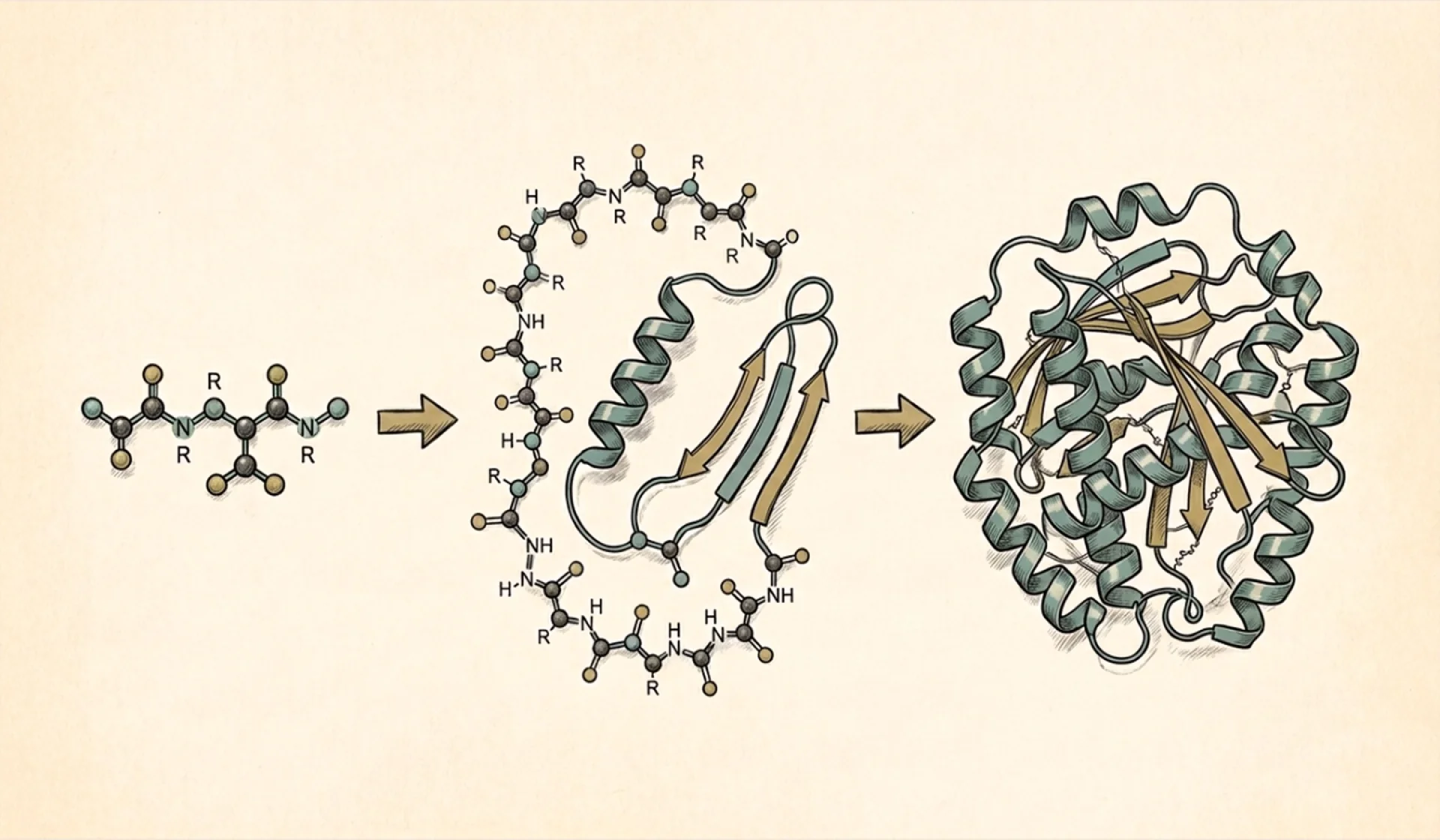
Peptide vs. Protein vs. Polypeptide: Definitions in Research
In laboratory research, distinguishing peptides from proteins by structural definition directly informs experimental design, selection of analytical methods, and the comparison of published findings. Yet the terms peptide, polypeptide, and protein appear in the literature with overlapping and sometimes inconsistent usage. This article clarifies the terminology, explains the rationale behind the conventional cutoffs, and shows where the distinctions matter in research contexts.
At a Glance
- Peptide:typically 2 to 50 amino acid residues joined by peptide bonds. Examples in research include BPC-157 (15 residues), GHK-Cu (3 residues), and semaglutide (31 residues).
- Polypeptide:an umbrella term for any chain of amino acids linked by peptide bonds, with no strict length cutoff.
- Protein:generally longer than 50 residues, with a defined tertiary and often quaternary structure.
The 50-residue threshold is a convention rather than a physical law, and it is treated differently across textbooks and journals. Below, we examine the convention, why it persists, and how to read across inconsistent literature usage.
The Molecular-Weight Divide: Why 50 Amino Acids Matters
The boundary between peptide and protein has been an active topic in biochemistry pedagogy since the early twentieth century. The 50-residue threshold dates from a period when most well-characterized small bioactive molecules were below this length and most enzymes were above it.
Historical Convention: The 50-Amino-Acid Threshold
Insulin, characterized by Sanger and Tuppy in 1951, contains 51 amino acids across its A and B chains and is generally classified as a protein (Sanger and Tuppy, 1951; PMID 14848194). Glucagon, with 29 residues, is universally described as a peptide hormone.
Oxytocin and vasopressin, each with 9 residues, are peptide hormones. The convention emerged because most biological functions performed by molecules in the 30 to 50 residue range looked more peptide-like, while molecules longer than 50 residues frequently exhibited enzyme-like behavior with defined tertiary folds.
Some authors use a 40-residue cutoff, others use 100, and a small number prefer molecular weight thresholds (10 kDa is a common value). The IUPAC nomenclature emphasizes the chemical linkage rather than length, treating peptide as a general term for any compound containing two or more amino acids joined by peptide bonds.
Functional Consequence: Folding, Solubility, and Receptor Selectivity
The 50-residue convention has empirical merit. Below this length, most molecules lack a stable hydrophobic core and rely on local secondary structure (alpha helix, beta turn, polyproline II) for receptor recognition. Above this length, hydrophobic residues are typically buried in a defined fold, and disruption of the fold (denaturation) usually destroys function.
This functional difference has real consequences in laboratory practice. Peptides typically tolerate organic cosolvents, brief heating, and lyophilization without losing biological activity, while many proteins do not. Peptides are usually purified by reversed-phase HPLC, while proteins are more often purified by ion exchange, size exclusion, or affinity chromatography (Mant et al., 2007; PMID 17629798).
Peptides: 2 to 50 Amino Acids Linked by Peptide Bonds
The peptide category is broad, ranging from dipeptides (two residues) to molecules approaching the 50-residue boundary. Across this range, the chemistry of the peptide bond is identical, but the biological behavior diverges significantly.
Dipeptides, Tripeptides, and Small Peptides
Some of the most studied research peptides are remarkably short. Carnosine, a beta-alanyl-L-histidine dipeptide, is one of the most extensively characterized small peptides in muscle physiology research (Boldyrev et al., 2013; PMID 23899568).
KPV, a tripeptide, has been studied as an anti-inflammatory pathway probe in animal models. GHK-Cu, also a tripeptide bound to copper, is one of the most cited peptides in extracellular matrix research (Pickart and Margolina, 2018; PMID 30190671).
Tetrapeptides through small peptides of 10 to 20 residues constitute the majority of research peptides studied for receptor-mediated mechanisms. The bioregulator family characterized by Khavinson and colleagues includes many tetrapeptides (Cartalax, Vilon, Livagen, Vesugen) studied for tissue-specific gene expression effects.
Structural Diversity: Linear, Cyclic, Branched Forms
Within the peptide category, topology adds further diversity. Linear peptides have a free N-terminus and a free C-terminus. Cyclic peptides close the chain through a covalent linkage, often a head-to-tail amide bond or a side-chain disulfide bridge. Branched and stapled forms add geometric constraints that can lock the peptide into a particular conformation.
Proteins: The 50-Plus Amino Acid Boundary
Beyond approximately 50 residues, the molecule typically gains the ability to bury hydrophobic residues in a defined core, fold into a discrete tertiary structure, and assemble into multi-subunit quaternary forms.
Tertiary and Quaternary Structure: Why Folding Becomes Dominant
Tertiary structure refers to the three-dimensional arrangement of all atoms in a single polypeptide chain, while quaternary structure describes the assembly of multiple folded chains into a complex. Proteins almost always derive their function from tertiary or quaternary architecture, and disruption of that architecture (heat denaturation, urea, guanidinium) destroys function. The structural rules that govern protein folding were formalized in classic studies by Anfinsen and others (Anfinsen, 1973; PMID 4124164).
Functional Complexity: Enzymes, Antibodies, and Regulatory Proteins
The most familiar proteins in laboratory research are enzymes (catalysts that operate through a defined active site), antibodies (molecules that bind antigens through a hypervariable loop region), and regulatory proteins (transcription factors, kinases, GTP-binding proteins). All of these depend on a folded tertiary structure that brings residues distant in primary sequence into close proximity in three-dimensional space.
Researchers selecting between a peptide and a protein for an experiment should consider whether the goal is to engage a well-defined receptor binding pocket (where a short peptide may suffice) or to mimic a complex multi-residue interface (where a folded protein domain may be required).
Polypeptides: The Umbrella Term for All Amino Acid Chains
The term polypeptide is broader than either peptide or protein. It includes any chain of amino acid residues linked by peptide bonds, regardless of length.
In strict usage, every peptide is a polypeptide, and every protein is also a polypeptide. In practice, the term polypeptide is often used to describe molecules that fall in the gray zone between the typical peptide range and the typical protein range, or to describe a single chain of a multi-chain protein complex.
Distinction from Peptide and Protein in Common Usage
Many researchers use polypeptide for chains of approximately 30 to 100 residues that are too long to fit comfortably into the peptide category but lack the discrete tertiary fold of a protein. Examples include the A and B chains of insulin treated separately, certain growth factor fragments, and partially synthetic constructs that are still being characterized.
When Polypeptide Is More Precise Than Peptide/
In structural biology papers, the term polypeptide chain is preferred when describing one strand of a multi-chain complex, since each chain is a separate polypeptide that may pair with others to form the complete protein. In synthesis chemistry, polypeptide is sometimes used to emphasize the polymeric nature of the molecule, particularly for synthetic copolymers where the chain length is intentionally variable.
Why This Distinction Matters in Research and Literature?
These definitions have practical consequences across at least three dimensions of research practice.
Pharmacokinetics: How Size Affects Absorption and Half-Life
Peptides under approximately 10 residues are often filtered rapidly by the kidneys in animal model studies, leading to short circulating half-lives unless modified. Larger peptides and proteins are cleared more slowly, often through receptor-mediated endocytosis or proteolysis (Werle and Bernkop-Schnürch, 2006; PMID 17034591). Peptides longer than approximately 30 residues are large enough to begin acquiring some of the pharmacokinetic features of proteins.
This size-dependent behavior shapes analog design. Pegylation, lipidation, and albumin-binding moieties are common strategies to extend the apparent half-life of small peptides into a range comparable to that of proteins.
Analytical Methods: MS, HPLC, and SDS-PAGE Applicability
Mass spectrometry works for both peptides and proteins, with different ionization and fragmentation strategies for each. HPLC purity analysis is the standard for peptides, while proteins are more often analyzed by SDS-PAGE for size and ion exchange chromatography for purity. Knowing whether the molecule under study is a peptide, polypeptide, or protein guides the selection of appropriate analytical methods.
Literature Search Strategy: Knowing Which Term Authors Use
A practical literature tip: when searching for research on a borderline molecule (40 to 60 residues), include all three terms in the search string. Some authors will describe the same molecule as a peptide in one paper and as a polypeptide in another, depending on the journal style and the focus of the paper. PubMed searches that combine peptide OR polypeptide OR protein with the molecule name will return the broadest set of relevant results.
Frequently Asked Questions
Q. Is every peptide a polypeptide?
Yes. Polypeptide is the umbrella term for any chain of amino acids joined by peptide bonds. Peptide is more specific, usually referring to chains of 2 to 50 residues. Every peptide is a polypeptide, and every protein is also a polypeptide.
Q. Why do researchers use different size cutoffs in different papers?
The 50-residue threshold is a convention rather than a physical law. Some authors use 40 residues, others use 100, and some use molecular weight thresholds. Always check a paper’s definition, especially in fields where nomenclature is contested or evolving.
Q. Does a longer peptide always have different pharmacokinetics?
In general, yes. Larger peptides are metabolized more slowly and have longer circulating half-lives in animal model studies, but they often have poorer absorption across membranes. Cyclic and stapled analogs can alter these size-dependent relationships substantially.
Q. Can a peptide unfold like a protein?
Peptides are generally more flexible than proteins. They may adopt secondary structures such as alpha helix, beta turn, or polyproline II in solution, but rarely fold into discrete tertiary structures without external constraints such as cyclization, stapling, or binding to a receptor.
Q. What analytical methods work best for peptides versus proteins?
HPLC and mass spectrometry work for both. For peptides, reversed-phase HPLC purity is the standard analytical readout. For proteins, size exclusion chromatography, ion exchange chromatography, and SDS-PAGE are more common due to larger size and structural complexity.
References
- Anfinsen CB. Principles that govern the folding of protein chains. Science. 1973;181(4096):223-230. PMID 4124164.
- Boldyrev AA, Aldini G, Derave W. Physiology and pathophysiology of carnosine. Physiol Rev. 2013;93(4):1803-1845. PMID 23899568.
- Mant CT, Chen Y, Yan Z, et al. HPLC analysis and purification of peptides. Methods Mol Biol. 2007;386:3-55. PMID 17629798.
- Pickart L, Margolina A. Regenerative and Protective Actions of the GHK-Cu Peptide in the Light of the New Gene Data. Int J Mol Sci. 2018;19(7):1987. PMID 30190671.
- Sanger F, Tuppy H. The amino-acid sequence in the phenylalanyl chain of insulin. Biochem J. 1951;49(4):463-481. PMID 14848194.
- Werle M, Bernkop-Schnürch A. Strategies to improve plasma half life time of peptide and protein drugs. Curr Pharm Biotechnol. Amino Acids 2006 (PMID 16622600).
Research-only disclaimer. The peptides described in this article are sold and discussed for laboratory and research purposes only. They are not intended for human consumption, diagnostic use, or therapeutic application. All scientific claims are based on peer-reviewed literature, with PubMed identifiers provided for verification.
Educational notice. This article is for educational and informational purposes only and is intended for licensed researchers and laboratory professionals. The peptides discussed are research chemicals sold for laboratory and research applications. They are not intended for human consumption, diagnostic use, or therapeutic application.
Verified Laboratory Research Standard
≥99% Purity • Published COAs • Fast Domestic USA Shipping
Source Lab-Tested Research Peptides with Published COAs
Sourcing verified research peptides for your laboratory? PrecisionsPeptides.com provides third-party HPLC & MS verified compounds with full batch transparency.


