
Cart
A History of Peptide Research: From Insulin (1921) to Modern GLP-1 Agonists
The history of peptide science from Banting and Best’s insulin breakthrough in 1921 to the modern triple-agonist research molecules of the 2020s illuminates why peptides remain central to drug discovery and laboratory research today. Reading the literature with awareness of this arc helps contemporary researchers place new findings in context and recognize methodological lineages that connect classic and current studies.
This article traces the scientific evolution of peptides as research and therapeutic tools across roughly a century, with attention to the key milestones, the analytical methods that enabled them, and the unresolved questions that drive current work.
At a Glance
- 1921: Insulin extraction from pancreatic tissue at the University of Toronto. The first peptide hormone with a defined therapeutic application.
- 1953-1955: First synthetic peptide hormones (oxytocin, vasopressin) reported by du Vigneaud, who received the 1955 Nobel Prize in Chemistry.
- 1963: Merrifield publishes solid-phase peptide synthesis (SPPS), enabling rapid synthesis of arbitrary sequences.
- 1980s-1990s: Growth hormone secretagogue chemistry advances rapidly, with Ipamorelin, GHRP-2, GHRP-6, Sermorelin, and CJC-1295 all entering the research literature.
- 2005-2017: GLP-1 receptor agonist generation: exenatide (2005), liraglutide (2010), semaglutide (2017).
- 2022-2023: Multi-receptor agonists: tirzepatide (dual GLP-1 and GIP), retatrutide (triple GLP-1, GIP, glucagon receptor) reported by Jastreboff et al.
Also Read: What are Peptides?
The Insulin Era (1921 to 1950): Discovery and Clinical Validation
The story of peptide therapeutics begins in May 1921 in a small laboratory at the University of Toronto, where surgeon Frederick Banting, medical student Charles Best, and biochemist James Collip, working under the supervision of John Macleod, set out to isolate the active principle from pancreatic extracts.
Banting and Best: Extraction from Pancreatic Tissue
Banting’s hypothesis was that previous attempts to isolate the antidiabetic factor from pancreas had failed because the proteolytic enzymes in pancreatic tissue degraded the active principle during extraction. He proposed ligating the pancreatic ducts in dogs to atrophy the exocrine tissue while leaving the islets of Langerhans intact, then extracting the active material from the residual tissue.
The first injections of the extract into a diabetic dog (named Marjorie) reduced blood glucose, and the team progressed rapidly through purification refinements led by Collip (Banting et al., 1922; PMID 20313484). On January 11, 1922, the first patient, Leonard Thompson, received insulin at Toronto General Hospital. The clinical effect was dramatic, and the discovery earned Banting and Macleod the 1923 Nobel Prize in Physiology or Medicine.
Purification and First Human Use: A Medical Revolution
The early extracts were impure. Subsequent decades saw progressive improvements in purification (Abel crystallized insulin in 1926, providing the first pure samples) and in formulation (Hagedorn introduced protamine insulin in 1936 to extend duration of action).
Sanger and Tuppy reported the complete amino acid sequence of insulin in 1951, the first protein primary structure to be solved (Sanger and Tuppy, 1951; PMID 14848194). This work earned Sanger the 1958 Nobel Prize in Chemistry.
Impact on Peptide Science: Proof That Peptides Are Therapeutic
The insulin story established several methodological precedents that shaped all subsequent peptide research. Extraction, purification, sequencing, structural characterization, structure activity relationship analysis, and analog design (the Hagedorn protamine insulin and later neutral protamine Hagedorn or NPH insulin) became the standard sequence of investigations for new peptide hormones.
Also Read: Peptide Bond Architecture
The Synthetic Peptide Revolution (1950s to 1970s): du Vigneaud and Merrifield
While insulin was being characterized, a parallel effort was underway to synthesize peptides chemically rather than rely on extraction.
Merrifield’s Solid-Phase Peptide Synthesis (SPPS): Enabling Rapid Synthesis
Vincent du Vigneaud reported the first chemical synthesis of oxytocin in 1953 and vasopressin shortly after, work that earned him the 1955 Nobel Prize in Chemistry. These syntheses were performed in solution and required laborious purification steps after each coupling.
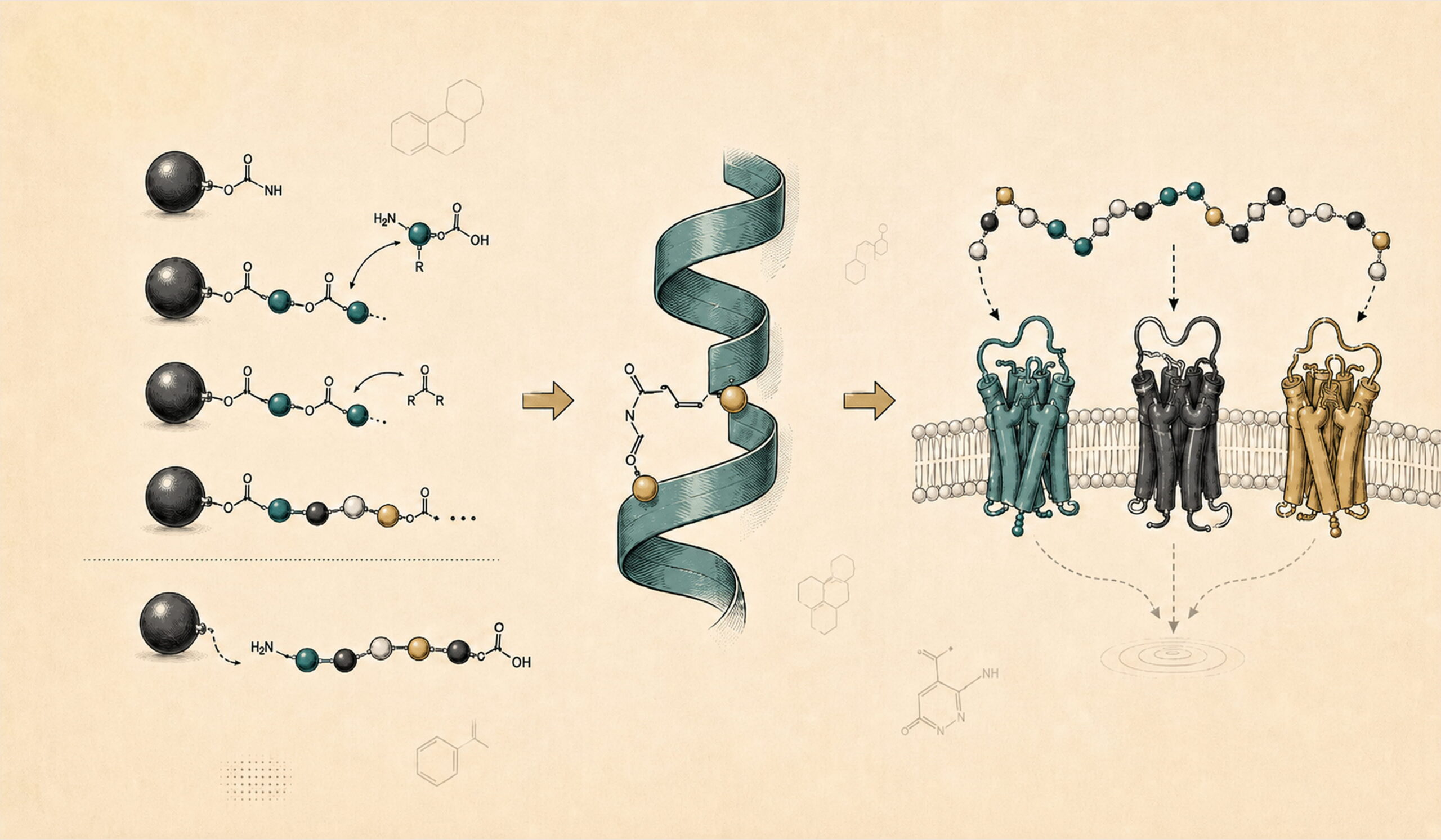
The transformation came in 1963 when Bruce Merrifield introduced solid-phase peptide synthesis (Merrifield, 1963; PMID 14048932). In SPPS the C-terminal amino acid is anchored to an insoluble polymer resin, and the chain is extended one residue at a time toward the N-terminus. After each coupling, excess reagents and byproducts are simply washed away from the resin.
This change accelerated peptide synthesis dramatically and made it accessible to ordinary research laboratories. Merrifield received the 1984 Nobel Prize in Chemistry.
Chemical Peptide Synthesis Over Extraction: Speed and Control
By the late 1960s, SPPS had supplanted extraction as the dominant method of obtaining peptides for research. The ability to incorporate non-natural amino acids, modify side chains, and produce custom sequences on demand opened the door to systematic structure activity relationship work that had previously been difficult or impossible.
Early Synthetic Peptide Drugs: Oxytocin, Vasopressin, and ACTH Analogs
Synthetic oxytocin was approved for clinical use in the 1950s, and synthetic vasopressin shortly thereafter. Adrenocorticotropic hormone (ACTH) analogs followed, including tetracosactide (the first 24 residues of human ACTH). These molecules established that synthetic peptides could match or exceed the activity of their natural counterparts.
Also Read: Peptide vs. Protein vs. Polypeptide
Growth Hormone Secretagogues: The 1980s to 1990s Expansion
The 1980s ushered in a wave of research on the somatotropic axis, with two parallel pharmacological strategies emerging.
Discovery of GHRP-6 and GHRP-2: Selective GH Release
Cyril Bowers and colleagues reported the first growth hormone-releasing peptide, GHRP-6, in 1984 (Bowers et al., 1984). GHRP-6 was a hexapeptide that selectively stimulated growth hormone release in vitro and in animal models. The receptor was not yet known, but the selectivity profile suggested a novel pathway distinct from the GHRH receptor that had been characterized earlier in the decade.
In the 1990s the receptor was cloned and named GHSR-1a. The endogenous ligand, ghrelin, was discovered in 1999 by Kojima and colleagues at the Hisamitsu group (Kojima et al., 1999; PMID 10604470). Ghrelin turned out to be a 28-residue acylated peptide produced primarily by the stomach, and the GHSR-1a receptor became a major target for pharmaceutical research.
Development of CJC-1295 and Ipamorelin: Improved Selectivity
Ipamorelin, reported by Raun and colleagues in 1998, was a more selective GHSR-1a agonist than the earlier GHRPs and showed reduced effects on cortisol and prolaction in animal model studies. CJC-1295, a GHRH analog with a drug affinity complex (DAC) that binds plasma albumin to extend half-life, was reported in the early 2000s (Teichman et al., 2006; PMID 16551736). These molecules continued the pattern of pharmacological refinement that began with GHRP-6.
Rise of GH-Releasing Hormone (GHRH) Analogs: Sermorelin and Tesamorelin
Sermorelin (the synthetic 1-29 fragment of human GHRH) and tesamorelin (a stabilized GHRH analog with an N-terminal modification) emerged from the GHRH side of the secretagogue pharmacology. Tesamorelin was approved as a therapeutic for a specific clinical indication in 2010. Research-grade tesamorelin remains a frequently studied molecule in the GHRH analog literature.
The GLP-1 Era (2000s to Present): From Single Agonists to Triple-Receptor Molecules
Glucagon-like peptide-1 (GLP-1) was identified in the 1980s as a product of post-translational processing of the proglucagon gene. Its incretin function (glucose-dependent stimulation of insulin secretion) was characterized in the 1990s.
GLP-1R Discovery and Early Agonist Development (2000s)
Native GLP-1 has a circulating half-life of approximately two minutes due to rapid degradation by dipeptidyl peptidase-4 (DPP-4). The pharmaceutical challenge was to engineer DPP-4 resistant analogs with longer half-lives. Exenatide, derived from exendin-4 in the saliva of Heloderma suspectum (the Gila monster), was the first solution, with a circulating half-life of approximately 2.4 hours. It was approved as a therapeutic in 2005.
Liraglutide (2010) extended this approach with a fatty acid attachment that promotes albumin binding, achieving a half-life of approximately 13 hours. Semaglutide (2017) extended further to approximately one week through a combination of fatty acid attachment, amino acid substitutions, and an alpha-aminoisobutyric acid replacement that resists DPP-4.
Dual GIP/GLP-1 Agonists: Tirzepatide (2022)
Tirzepatide is a 39-residue peptide that activates both the GLP-1 receptor and the glucose-dependent insulinotropic polypeptide (GIP) receptor (Coskun et al., 2018; PMID 30404862). The dual mechanism showed enhanced metabolic effects in preclinical and clinical research compared to GLP-1 mono-agonism.
Triple Agonist Research: Retatrutide and Next-Generation Molecules
Retatrutide is a triple agonist of GLP-1, GIP, and glucagon receptors. The Phase 2 results published by Jastreboff and colleagues in 2023 showed substantial metabolic effects (Jastreboff et al., 2023; PMID 37296781). Cagrilintide, a long-acting amylin analog, has also been studied in combination with semaglutide, illustrating the move toward multi-mechanism research.
Healing and Repair Peptides: The Tissue-Regeneration Boom
In parallel with the metabolic peptide arc, a separate line of research has explored peptides involved in tissue repair.
Discovery and Mechanism: Endogenous Peptide Sequences
BPC-157 (body protection compound, 15 residues) was originally derived from a sequence within human gastric juice. Sikiric and colleagues have published an extensive body of preclinical literature on its effects in animal models of tendon, ligament, and gastrointestinal injury (Sikiric et al., 2018; PMID 30238875).
TB-500, a synthetic fragment of thymosin beta-4, has been studied in cardiac, dermal, and neural injury models (Goldstein et al., 2012; PMID 22150430). GHK-Cu, a copper-bound tripeptide, has a deep literature on extracellular matrix gene expression (Pickart and Margolina, 2018; PMID 30190671).
Research Boom: 2010s to 2020s Growth in Preclinical Studies
The 2010s saw a substantial expansion of preclinical literature on healing peptides. The body of work spans rodent models of tendon and ligament injury, ischemia and reperfusion, gastric ulcer healing, and cutaneous wound healing.
Regulatory and Clinical Translation Challenges
Many healing peptides remain in research-only status because pivotal clinical studies meeting the regulatory standard for FDA approval have not been completed. The research literature is the appropriate framework for understanding their pharmacology.
Structural Innovations: From Linear to Cyclic to Stapled Peptides
Across the modern era, structural innovations have continually expanded the design space.
Cyclization and Stapling: Improving Half-Life and Selectivity
Cyclization (head-to-tail or side chain) has been used to lock active conformations and resist proteolysis since the early days of synthetic peptide chemistry. Stapling, introduced in the early 2000s, uses hydrocarbon staples to lock alpha-helical conformations and has expanded the reach of peptide therapeutics into intracellular protein-protein interactions (Schafmeister et al., 2000; PMID 11041467).
Pegylation and Modified Backbones: Expanding Pharmacokinetic Windows
Pegylation (attachment of polyethylene glycol chains) and lipidation (attachment of fatty acids that bind albumin) have become standard strategies for extending circulating half-life. PEG-MGF (pegylated mechano-growth factor), CJC-1295 with DAC, and semaglutide all illustrate the use of these strategies.
Current Trends: De Novo Peptide Design via AI and Computational Methods
The 2020s have seen an explosion of interest in computational peptide design. AI-based protein structure prediction tools and de novo design platforms now allow researchers to propose new sequences with predicted binding properties before any synthesis. These tools are likely to shape the next decade of peptide research.
Frequently Asked Questions
Q. Why was insulin’s discovery in 1921 so revolutionary?
Insulin was the first peptide hormone identified, isolated, and used to study a defined biological function. It transformed diabetes research and demonstrated that small protein-like molecules could be extracted, purified, sequenced, and used to investigate physiology. Every subsequent peptide research program rests on the methodological precedent set by the insulin work.
Q. How did Merrifield’s solid-phase peptide synthesis change peptide science?
Solid-phase peptide synthesis allowed researchers to synthesize peptides quickly and reliably on a polymer resin, washing away excess reagents at each step rather than purifying intermediates in solution. This made peptide chemistry accessible to ordinary research laboratories and enabled systematic structure activity relationship work.
Q. What was the first synthetic peptide drug?
Oxytocin (1953) and vasopressin (shortly after) were the first synthetic peptide hormones reported by du Vigneaud, work that earned the 1955 Nobel Prize in Chemistry. These were synthesized in solution before the SPPS era, and the chemistry was later adapted to solid-phase methods.
Q. Why did GLP-1 agonists become so dominant in recent years?
The GLP-1 receptor mechanism is well characterized, and successive generations of analogs have shown progressive improvements in pharmacokinetics. Engineering longer-acting molecules through DPP-4 resistant substitutions, fatty acid attachment, and multi-receptor agonism has produced a steady pipeline of research-relevant compounds.
Q. Are all modern research peptides synthesized via SPPS?
Most research peptides today are synthesized via SPPS or a closely related variant. Some larger molecules and proteins are produced by recombinant expression in bacterial or mammalian systems. SPPS remains the dominant route for sequences up to approximately 60 to 80 residues.
References
- Banting FG, Best CH, Collip JB, Campbell WR, Fletcher AA. Pancreatic Extracts in the Treatment of Diabetes Mellitus. Can Med Assoc J. 1922;12(3):141-146. PMID 20313484.
- Bowers CY, Momany F, Reynolds GA, Hong A. On the in vitro and in vivo activity of a new synthetic hexapeptide that acts on the pituitary to specifically release growth hormone. Endocrinology. 1984;114(5):1537-1545.
- Coskun T, Sloop KW, Loghin C, et al. LY3298176, a novel dual GIP and GLP-1 receptor agonist for the treatment of type 2 diabetes mellitus. Mol Metab. 2018;18:3-14. PMID 30404862.
- Goldstein AL, Hannappel E, Sosne G, Kleinman HK. Thymosin beta-4: a multi-functional regenerative peptide. Expert Opin Biol Ther. 2012;12(1):37-51. PMID 22150430.
- Jastreboff AM, Kaplan LM, Frias JP, et al. Triple Hormone Receptor Agonist Retatrutide for Obesity. N Engl J Med. 2023;389(6):514-526. PMID 37296781.
- Kojima M, Hosoda H, Date Y, Nakazato M, Matsuo H, Kangawa K. Ghrelin is a growth-hormone-releasing acylated peptide from stomach. Nature. 1999;402(6762):656-660. PMID 10604470.
- Merrifield RB. Solid Phase Peptide Synthesis. I. The Synthesis of a Tetrapeptide. J Am Chem Soc. 1963;85(14):2149-2154. PMID 14048932.
- Pickart L, Margolina A. Regenerative and Protective Actions of the GHK-Cu Peptide in the Light of the New Gene Data. Int J Mol Sci. 2018;19(7):1987. PMID 30190671.
- Sanger F, Tuppy H. The amino-acid sequence in the phenylalanyl chain of insulin. Biochem J. 1951;49(4):463-481. PMID 14848194.
- Schafmeister CE, Po J, Verdine GL. An All-Hydrocarbon Cross-Linking System. J Am Chem Soc. 2000;122(24):5891-5892. PMID 11041467.
- Sikiric P, Seiwerth S, Rucman R, et al. Stable Gastric Pentadecapeptide BPC 157. Pharmacology. 2018;101(3-4):158-168. PMID 30238875.
- Teichman SL, Neale A, Lawrence B, Gagnon C, Castaigne JP, Frohman LA. Prolonged stimulation of growth hormone (GH) and insulin-like growth factor I secretion by CJC-1295, a long-acting analog of GH-releasing hormone, in healthy adults. J Clin Endocrinol Metab. 2006;91(3):799-805. PMID 16551736.
Research-only disclaimer. The peptides described in this article are sold and discussed for laboratory and research purposes only. They are not intended for human consumption, diagnostic use, or therapeutic application.
Educational notice. This article is for educational and informational purposes only and is intended for licensed researchers and laboratory professionals. The peptides discussed are research chemicals sold for laboratory and research applications. They are not intended for human consumption, diagnostic use, or therapeutic application.


